What Makes a Photograph a Limited Edition?

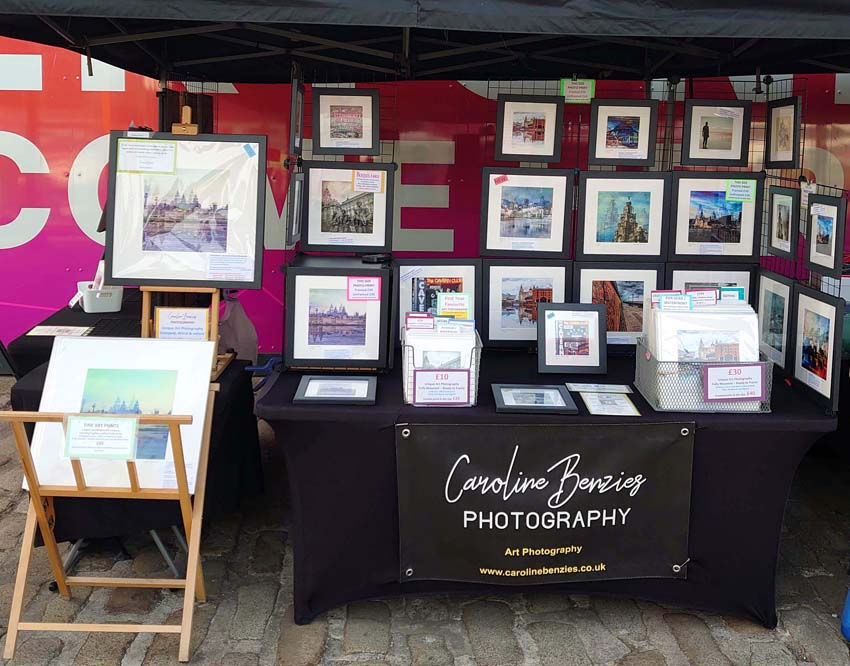
When I am selling my work at face to face events or in my Red Brick Market unit, I explain that the prints that people are looking at are limited edition or sometimes I will say that they are a ‘limited print run’, so this blog post is to explain just what that means!
When I first started selling my art photography prints (way back in 2018!), I didn’t number or sign my work. This was really a lack of confidence on my part, thinking - Will people even buy 1 print? Will I ever sell 50 of anything!? But, as I explained in my previous blog post ‘Why I photograph familiar places differently’, I decided that making my work limited editions was a way of making my art photography stand out more.
My prints are limited editions by size - the smaller photo prints are all editions of 100 prints, most of the standard size prints are a limited edition of 50 or 75. To confuse myself (!), I made some of the Gothic prints runs of 25 and some of the Nature prints a limited run of 30 (that was a bad idea on my part!). The fine art prints are more varied in the number of prints that will be produced.
So on my print mounts, as well as my name, you will see I write the title of the print and then some numbers underneath – for example 10/50 – this means that particular print is number 10 of a possible 50 in that size. It also means, if you buy that one – only 49 more people in the whole world will have it too!

How do I know how many prints to produce? I don’t really! Even after all this time, I find that I can’t really predict what prints will fly out immediately or which ones will be more of a ‘slow burner’!
When it’s gone, it’s gone!
What happens when I reach the end of an edition? I stop printing it! Even if it's still a popular image – as that’s what ‘limited edition’ means! So the beautiful ‘Liverpool In Rainbows’ photo print has recently just sold out - Thank you to the 50 people who own a standard size photo print and the 100 people that own a smaller photo print! Most of those prints stayed in the UK but quite a few have flown off round the world! Isn’t that amazing!
Sometimes this can be a little tricky to explain. Someone might see a standard size print on display and ask if they can buy a smaller one - but each size has its own limited edition. So, when I reach the end of an edition in one size, I can’t just print more! Sorry!
On my website, I try and highlight those prints that are near the end of their print run in the product descriptions. When I get down to just one print left, I tend to remove it from my website and put it out in my Red Brick Market space, just in case two people buy it online at the same time! And I pop a little note on, saying it’s the last one. This is not a hard sell tactic! It’s the truth!
As my work has developed, making prints limited edition also keeps me on my toes! It means I don’t get complacent or just rely on a couple of key images to sell. As a print comes to the end of its print run, I need to make sure that I have something else ‘waiting in the wings!’ to take its place. Sometimes, I will use the same subject matter but do a complete re-edit – so you will see prints such as Celebration and Celebration II, where I have taken the same subject – Sefton Park Palm House, but rearranged the photos that make up the image and changed the blended colours. Sometimes, I go out and take completely new photos of a subject but then edit them in a similar way - such as Across The Docks and Across The Docks II.
So when you see a limited edition print in my Red Brick Market space, at an event or on my website, the number isn't just something I've randomly written on the mount. It tells you that there is a finite number of those particular prints available.
For me, that's part of what makes owning one special. I know that when an edition reaches its final number, that's it!
And I quite like the fact that I still don't know which photograph is going to be the next one to sell out!